24/7 AI Receptionist for HVAC and Plumbing Companies: Stop Losing After-Hours Emergency Calls
A burst pipe at 11 PM does not leave a voicemail — it calls the next contractor on the list. Here is how HVAC and plumbing companies use a 24/7 AI receptionist to capture after-hours emergency calls, qualify jobs, and dispatch on-call techs without paying for a night-shift dispatcher.
By SAM's AI Services Team · 2026-06-12
It is 11:40 PM on a Friday in January. A homeowner's furnace just died, the house is dropping a degree every half hour, and they are doing what every homeowner does: calling HVAC companies off Google Maps, top to bottom.
The first company rings out. The second has a voicemail box — they hang up. The third answers on the first ring, confirms a tech can be there between 7 and 9 AM, quotes the after-hours trip fee, and books the job.
That third company did not have a dispatcher awake at midnight. It had an AI receptionist. And that single answered call was likely worth $600 to $1,200 — emergency HVAC and plumbing work routinely bills at 1.5 to 3 times standard rates.
This guide covers how 24/7 AI call answering works specifically for HVAC, plumbing, and other home service companies: the after-hours math, what the AI handles versus what your on-call tech handles, what it costs against a human answering service, and how to set it up in a couple of weeks.
Why After-Hours Calls Are the Whole Game in Home Services
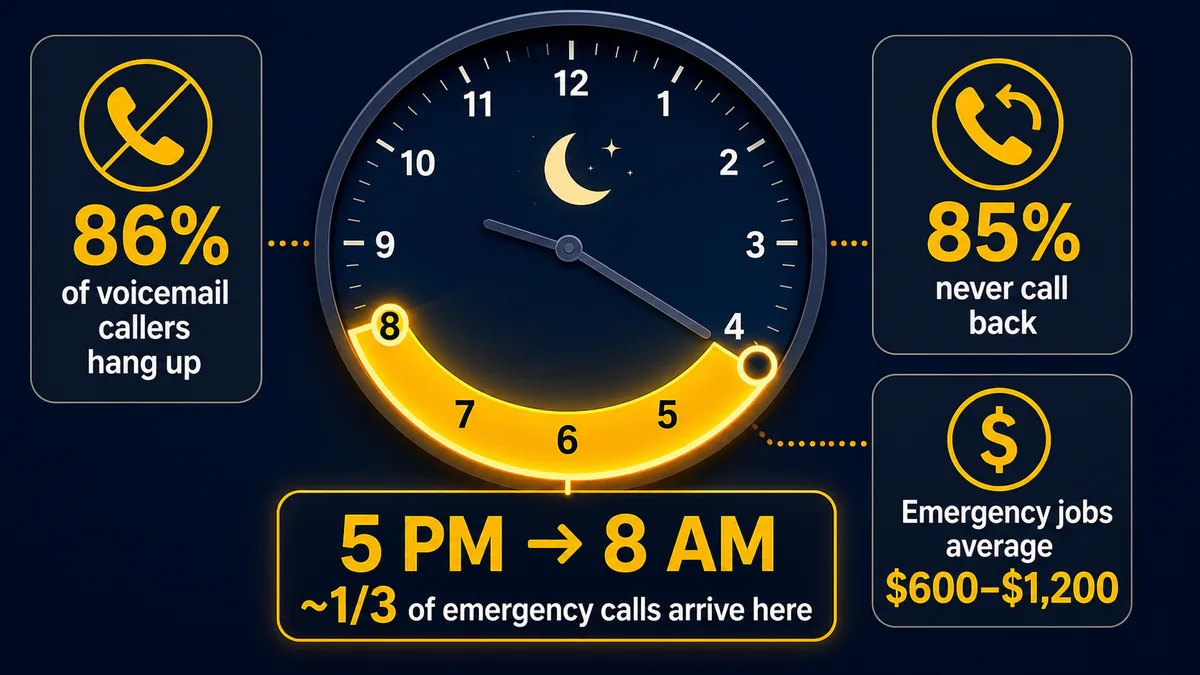
Home service demand does not respect business hours. Industry call data shows that roughly a third of emergency HVAC and plumbing calls come in between 5 PM and 8 AM, and when you add weekends and holidays, the majority of customer calls to home service companies arrive outside the 9-to-5 window.
Meanwhile, caller behavior studies are brutal: about 86 percent of callers who reach voicemail hang up without leaving a message, and roughly 85 percent of home-service callers who do not reach a live person never call back. They do not wait. A flooding basement does not allow waiting.
Put those together and the cost becomes concrete. Missed-call analyses in the trades put the expected value of a single missed call at $200 to $600 depending on your ticket mix, with emergency jobs averaging $600 to $1,200. One industry calculation found that missing just one emergency call per week costs a contractor on the order of $16,800 per month in lost revenue. Even if your numbers are half that, the leak is bigger than almost any other problem in your business — and unlike a marketing problem, it is fixable in two weeks.
What a 24/7 AI Receptionist Actually Does for a Contractor
An AI receptionist for a home service company is a voice agent that answers your existing business number with a natural voice, follows your call flow, and takes real action — not just messages. Configured properly for the trades, it does five things:
1. Answers every call on the first ring, at any hour. Midnight, Sunday, Thanksgiving. It also handles simultaneous calls, which matters during a heat wave or a deep freeze when your phone lights up all at once and a human dispatcher could only take one call at a time.
2. Qualifies the job with your questions. Is this an active leak or a dripping faucet? No heat entirely, or one cold room? Are you in our service area? Is this a home you own or a rental? You define the questions; the AI asks them consistently on every call, which is more than most tired humans manage at 2 AM.
3. Sets price expectations honestly. It quotes your after-hours trip fee and emergency rates up front, so your tech does not drive 40 minutes to a customer who balks at the price on the doorstep.
4. Dispatches or books. True emergencies get routed to your on-call tech's phone with a text summary: name, address, problem description, and what was quoted. Non-emergencies get booked into tomorrow's schedule directly in ServiceTitan, Jobber, or Housecall Pro. The 2 AM "my AC is making a weird noise" caller becomes a 9 AM appointment instead of a competitor's customer.
5. Logs everything. Every call is transcribed. Your morning starts with a list of what came in overnight, what was booked, what was dispatched, and what needs a callback — instead of a voicemail box of hang-ups.
AI Receptionist vs. Human Answering Service vs. On-Call Rotation
Contractors have traditionally solved after-hours coverage three ways, and each has a known failure mode:
The owner's cell phone. Free, and the reason you have not had an uninterrupted dinner since you started the company. It also stops scaling the day you have more than a handful of techs.
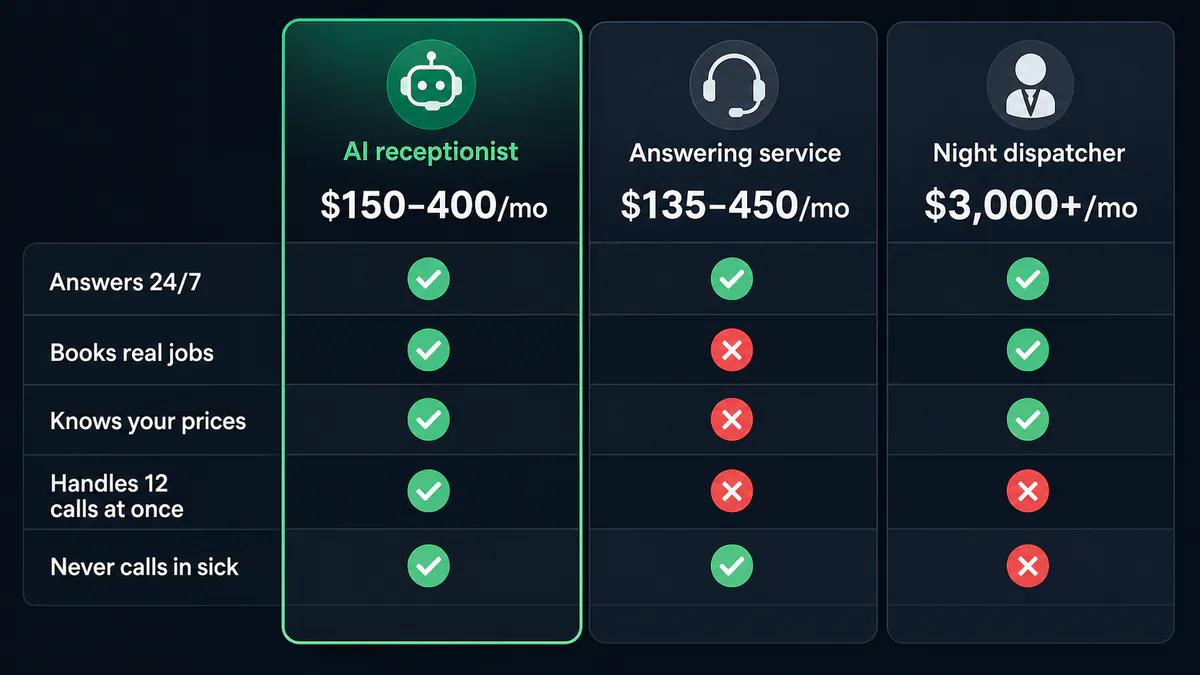
A traditional answering service. Typically $135 to $450 per month for small-business plans, and the better trade-focused ones cost more. The operators are human, but they are reading a generic script for fifty different companies. They cannot answer "do you service heat pumps?" and they usually cannot see your schedule — so everything becomes a message for someone to deal with in the morning, which is exactly the delay that loses the customer.
Making techs answer the phone on rotation. Your most expensive labor doing unpaid phone duty, badly, while half asleep. Techs hate it, qualification is inconsistent, and burnout shows up in your turnover.
The AI receptionist option generally runs $150 to $400 per month flat for typical small-contractor volume. It knows your services, your rates, and your coverage area because it is trained on them; it answers instantly and in parallel during call surges; and it only wakes your on-call tech for calls that pass your own emergency criteria. The tech gets a transcript instead of a cold handoff.
The honest limitation: a small share of callers — usually older customers or complicated commercial situations — will want a human and nothing else. Good setups handle this with an immediate "transfer me to a person" path rather than trapping anyone in a loop. You are not eliminating humans from your phone; you are stopping the bleeding at the hours no human was answering anyway.
Seasonal Surges: Where AI Coverage Quietly Prints Money
Every contractor knows the pattern. The first 95-degree week of summer, or the first hard freeze of winter, and call volume triples for ten days. Those are the most profitable days of your year — and the days your phone coverage fails hardest, because a human can only take one call at a time and your competitors' phones are slammed too.
An AI receptionist has no concept of a busy signal. Twelve calls in the same ten minutes get twelve immediate answers, twelve qualification conversations, and a triaged list: three emergencies dispatched, seven appointments booked across the next two days, two out-of-area callers politely declined. Surge weeks are where contractors who adopted AI answering describe the system as paying for its entire year.
Does This Work in My Market?
The playbook works anywhere people call contractors — which is everywhere. We set these systems up for home service companies across the United States and Canada, and the same approach works for plumbers, heating engineers, and electricians in the United Kingdom and Ireland, where emergency callout culture is just as strong and a missed boiler-failure call in a Manchester January is every bit as expensive as a missed furnace call in Minneapolis.
Localization is straightforward: local number routing, your local rates and callout fees in the knowledge base, service-area boundaries by zip or postcode, and a voice that matches your market. In Australia and New Zealand the after-hours premium economics are identical — only the seasons flip.
Setting It Up: A Realistic Two-Week Plan
Days 1–3: Write your call playbook. Your emergency criteria, your after-hours rates and trip fees, your service area, your top 20 caller questions with exact answers, and the on-call schedule. If you cannot write down what counts as an emergency, neither a human service nor an AI can triage for you — this document is the real work.
Days 4–7: Wire it up. Forward after-hours calls from your existing number, connect your field service software for booking, and set the dispatch path to your on-call rotation. No new phone number, no rip-and-replace.
Days 8–14: Test like a hostile customer. Call it at midnight. Pretend to be out of area. Pretend to be a price-shopper, an angry customer, a tenant whose landlord should be billed. Fix what breaks. Then go live on after-hours calls and review every transcript for the first two weeks.
Then measure one number: booked jobs from calls outside business hours. Multiply by your average ticket. That is the ROI line, and for most contractors it is visible in the first month.
This is the same buildout we do for clients as part of our AI automation and workflow services — call flows, qualification logic, dispatch integration, and the lead follow-up automation covered in our guide to AI automation tools for small businesses.
Your Next Emergency Call Is Coming. Who Answers It?
SAM's AI Services builds 24/7 AI receptionists for HVAC, plumbing, and home service companies — trained on your rates and your rules, dispatching to your real on-call rotation, capturing the after-hours jobs your voicemail has been donating to competitors.
Get a free call-coverage assessment here or call +1 (415) 287-2654. Bring your last month's missed-call count if you have it — the math takes five minutes.
Frequently Asked Questions
How much does an AI receptionist cost for an HVAC or plumbing company?
Typical small-contractor plans run $150 to $400 per month flat, depending on call volume and software integrations. Compare that to $135 to $450 per month for a traditional message-taking answering service, or several thousand per month for night dispatcher coverage. A single captured emergency job usually covers a month of service.
Can the AI tell the difference between a real emergency and a routine call?
Yes, using rules you define. You specify what qualifies — active leak, no heat, sewage backup — and the AI asks those questions on every call. Qualified emergencies are dispatched to your on-call tech immediately; everything else is booked as a normal appointment. You control the threshold, and you can tighten it weekly based on transcripts.
Does it integrate with ServiceTitan, Jobber, or Housecall Pro?
The major AI receptionist platforms integrate with common field service software either natively or through middleware like Zapier and Make. That allows the AI to book real schedule slots, create job records with the caller's details, and send your tech a summary rather than a raw voicemail.
What happens during a call surge, like a heat wave or deep freeze?
This is where AI answering clearly beats human coverage: it takes unlimited simultaneous calls. Every caller gets answered on the first ring even when twelve people call in the same ten minutes, and the system outputs a triaged list of dispatches and bookings instead of a queue of hang-ups.
Will customers with an emergency accept talking to an AI?
A caller with a flooding kitchen wants speed, a price, and an arrival window — in that order. An immediate answer that delivers all three beats a voicemail box every time. Industry data shows around 86 percent of callers will not leave a voicemail, while well-configured AI receptionists resolve most emergency calls in under three minutes. Always include an instant human-transfer option for callers who ask.
Does this work outside the United States?
Yes. The same systems work for contractors in Canada, the United Kingdom, Ireland, Australia, and New Zealand. Setup is localized with your local numbers, callout fees, service-area postcodes, and a voice accent that fits your market.