AI Answering Service for Small Law Firms: Capture Every Client Intake Call, 24/7
A person who just got arrested, injured, or served papers calls a lawyer once — and hires whoever answers. Here is how solo attorneys and small firms use a 24/7 AI answering service to capture every intake call, pre-screen leads with conflict-safe questions, and book consultations while they are in court.
By SAM's AI Services Team · 2026-06-12
There is a category of phone call that almost never happens twice. A person who was just arrested, just served divorce papers, or just got out of the emergency room after a crash picks up the phone and calls a lawyer. If a human answers, that firm probably gets the case. If voicemail answers, the caller dials the next firm on the list — and never calls back.
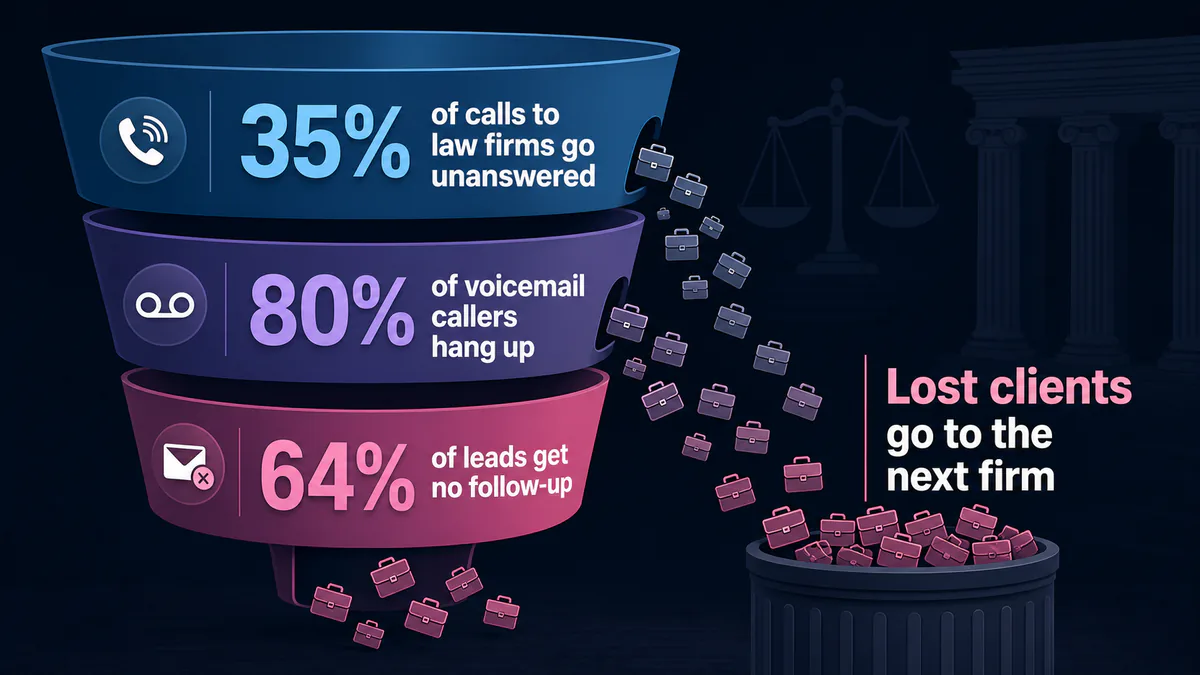
The numbers on this are stark. A national study that placed 1,200 test calls to law firms found that 35 percent went completely unanswered. Of the callers who reached voicemail, 80 percent hung up without leaving a message. Separate intake research found that 64 percent of prospective clients who reached out to a firm received no follow-up at all — by phone or email.
For large firms with staffed reception desks, this is an efficiency problem. For solo attorneys and two-to-ten-lawyer firms, it is the single largest leak in the practice: you are in court, in depositions, or in consultations during the exact hours prospective clients call, and every hour of paid marketing pours leads into a phone nobody can answer.
This guide covers the fix that small firms are adopting in 2026 — a 24/7 AI answering service built for legal intake — including what it can and cannot ethically do, how conflict-safe screening works, what it costs against a human intake service, and how to set it up properly.
What Is an AI Answering Service for a Law Firm?
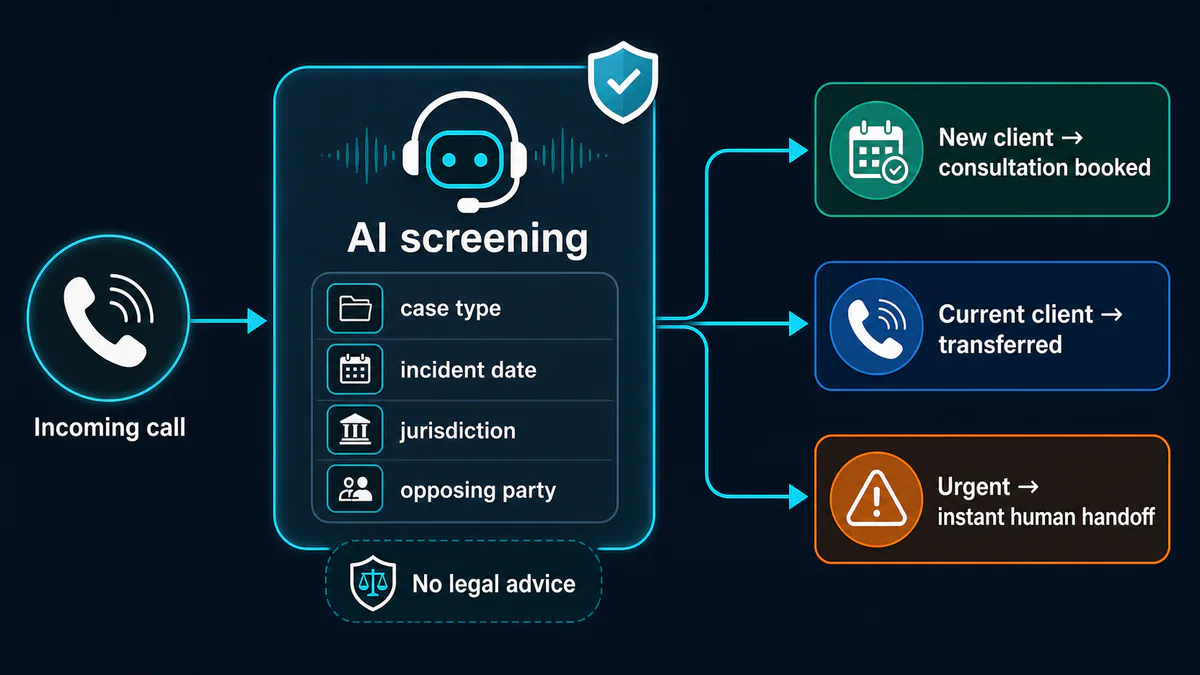
An AI answering service is a voice assistant that answers your firm's existing phone number with a natural, professional voice, follows an intake script you approve, and takes real action during the call: it screens the lead, captures the case details, books a consultation into your real calendar, and logs everything — with a transcript — into your intake software.
Configured correctly for a law practice, it handles four jobs:
- Answering every call, 24/7, including the evening and weekend hours when people in crisis actually call lawyers, and the business hours when you are in court and your one staff member is at lunch.
- Running consistent intake screening — case type, incident date, jurisdiction, how they found you, opposing party name — the same questions in the same order, on every single call, which human intake rarely achieves.
- Booking consultations directly into your calendar with confirmation texts, instead of leaving "please call back" messages that go stale.
- Routing what matters now. Current clients, courts, and opposing counsel can be recognized by your rules and transferred or flagged differently from new intake calls.
What it must not do is just as important, and it is where legal differs from every other industry: the AI must never give legal advice, never quote case outcomes, and never create the impression that an attorney-client relationship has been formed on the call. The serious platforms are built around these guardrails; the setup work is making your script enforce them.
The Intake Math for a Small Firm
Work through your own numbers, because this is where the decision makes itself.
Say your firm gets 60 inbound calls a month from prospective clients. At the industry's 35 percent unanswered rate, about 21 of those calls go nowhere. If 80 percent of those callers refuse to leave voicemail and move on, you lose roughly 17 prospective clients a month before any human at your firm knows they existed.
Now apply your practice area's economics. A family law retainer, a personal injury contingency case, an estate plan, a criminal defense fee — for most small firms, even one recovered case per month is worth several thousand dollars at minimum. The leak is not marginal. For many firms it is the difference between a flat year and a growth year, and it is happening silently, with no record, which is why most owners drastically underestimate it.
Speed compounds the effect. Legal lead studies show only about a quarter of firms respond to new leads within five minutes, while research across industries finds the first responder wins the client roughly 78 percent of the time. The firm that books the consultation during the first call — not the firm with the best website — gets the case.
Can an AI Ethically Handle Legal Intake?
Yes, within clear boundaries, and bar guidance across US jurisdictions has been converging on the same practical rules that apply to human non-lawyer intake staff:
No legal advice, period. The AI answers process questions ("the consultation is 30 minutes, here is what to bring") and refuses substance questions ("do I have a case?") with a scripted redirect to the consultation. This is the same line your paralegal already walks — the AI just never gets tired and improvises.
Conflict-safe data collection. The script collects the opposing party's name so your team can run a conflict check before the consultation, and the platform should store call data encrypted with access controls. Look for providers that will sign confidentiality terms and, in the UK and Ireland, GDPR data processing agreements.
Honest disclosure. The assistant should not pretend to be a human employee. In practice this costs almost nothing — callers in urgent situations care about being helped immediately, not about who answered — and it keeps you clean on emerging AI-disclosure rules.
Human escalation always available. Current clients with urgent matters, callers who ask for a person, and anything resembling an emergency should transfer immediately to your designated line, with the transcript attached so nobody repeats themselves.
Treat the AI exactly as you would a new intake hire: give it a script you would defend to your bar, supervise its early work by reading transcripts, and tighten the rules as you go.
AI vs. Human Legal Answering Services
Small firms have used human legal answering services for decades, and the good ones are genuinely good. The comparison in 2026 looks like this:
Human legal answering services typically charge by the minute or by call volume, commonly landing between $300 and $1,000+ per month for meaningful coverage. Operators are trained but shared across many firms, intake depth varies with who picks up, and after-hours coverage at quality tiers gets expensive fast. What you get that AI cannot fully match: human warmth on genuinely distressed calls.
AI answering services typically run $150 to $500 per month flat, answer instantly at any hour with no per-minute anxiety, run your exact script with perfect consistency, handle simultaneous callers, book directly into your calendar, and produce searchable transcripts of every call. What you give up: a small percentage of callers who want a human and will not proceed — which is why the instant-transfer path is non-negotiable.
The hybrid most small firms land on: AI answers first on after-hours, weekends, and overflow; your staff or a human service takes warm transfers and sensitive matters. Total cost usually drops while answer rates go from roughly 65 percent to effectively 100 percent.
Which Practice Areas Benefit Most?
Personal injury and criminal defense see the largest gains because urgency is extreme and calls cluster at night and on weekends — exactly when nobody staffs the phone. Family law is close behind; people call about divorce and custody when the house is quiet. Immigration, employment, and tenant-side practices benefit from multilingual AI voices that answer in the caller's language. Estate planning and business law see smaller but still real gains, mostly from overflow capture and consistent consultation booking.
The same logic applies outside the United States. Solicitors in the United Kingdom and Ireland, and small firms in Canada, Australia, and New Zealand, face identical intake economics — the localization is your jurisdiction's terminology, your regulator's advertising and disclosure rules, and GDPR-compliant data handling where applicable. We configure these systems for English-speaking markets on both sides of the Atlantic.
Getting It Live in Three Weeks
Week 1 — Script and rules. Document your intake questions per practice area, your disqualifiers (cases you refer out), your conflict-check data requirements, consultation booking rules, and your no-advice guardrails. An afternoon of partner time, and the single highest-leverage step.
Week 2 — Wiring. Forward after-hours and overflow calls from your existing number. Connect your calendar and your intake CRM — Clio Grow, Lawmatics, or even a structured email-and-spreadsheet flow if that is what you run today.
Week 3 — Adversarial testing, then launch. Call it pretending to be a distressed parent, a price shopper, opposing counsel, a current client with an emergency, and someone explicitly asking "should I plead guilty?" Verify the guardrails hold and the transfers fire. Then go live after-hours first, read every transcript for two weeks, and expand to daytime overflow once you trust it.
If you want this built and tuned for you — script design, guardrails, calendar and CRM integration, and the follow-up automation that nurtures booked leads — that is what our AI automation services cover. The follow-up half of the system is covered in our guide to AI automation for small business.
Your Next Client Is About to Call. Once.
SAM's AI Services builds 24/7 AI intake answering for solo attorneys and small firms — conflict-safe screening, strict no-advice guardrails, real calendar booking, and transcripts of every call.
Book a free intake assessment here or call +1 (415) 287-2654. We will estimate your current missed-call leak from your call logs in one short working session.
Frequently Asked Questions
How much does an AI answering service cost for a small law firm?
Most small firms pay $150 to $500 per month flat depending on call volume and integrations, versus roughly $300 to $1,000+ per month for comparable coverage from a human legal answering service billed by the minute. One recovered case per quarter typically pays for years of service.
Can an AI answering service give legal advice to callers?
No, and it must be configured never to try. A properly set up legal AI receptionist answers process and scheduling questions only, deflects all substantive legal questions to a booked consultation, and never quotes outcomes — the same rules that govern human non-lawyer intake staff.
How does conflict checking work with AI intake?
The AI collects the opposing party's name and matter details during the call and logs them with the transcript before any consultation happens. Your team runs the conflict check against that data, exactly as with human intake — the difference is the data is captured consistently on every call.
Is client information collected by the AI confidential?
Choose a platform with encrypted storage, access controls, and contractual confidentiality terms. Pre-consultation intake information is handled like any prospective-client data your staff would take. Firms in the UK and Ireland should additionally require a GDPR data processing agreement and check data residency.
Will potential clients in a crisis talk to an AI?
The realistic comparison is not AI versus your best paralegal — it is AI versus voicemail at 9 PM, where 80 percent of legal callers hang up. An immediate, calm answer that books a consultation within minutes outperforms a callback the next morning, and callers who want a human are transferred instantly.
Does AI legal intake work outside the United States?
Yes. Small firms and solicitors in the United Kingdom, Ireland, Canada, Australia, and New Zealand use the same systems. Localization covers your jurisdiction's terminology, regulator disclosure rules, local phone routing, and GDPR-compliant data handling where it applies.