AI Receptionist for Chiropractors: How 24/7 Call Answering Fills Your Appointment Book
Your front desk cannot answer the phone while checking in a patient, and most callers who hit voicemail never call back. Here is how a 24/7 AI receptionist keeps a chiropractic clinic booked — what it handles, what it costs, and how to set one up without disrupting your practice.
By SAM's AI Services Team · 2026-06-12
Every chiropractor knows this moment. You are mid-adjustment, hands on a patient, and you hear the front desk phone ring four times and stop. Your receptionist is checking someone in. The caller hit voicemail.
That caller was very likely a new patient with acute back pain — the kind of person who does not wait patiently for a callback. They are already dialing the next clinic on Google Maps.
This article is a practical guide to the fix that small clinics are adopting fast in 2026: a 24/7 AI receptionist. We will cover what it actually does, what the missed-call math looks like for a chiropractic office specifically, what it costs compared to hiring, where HIPAA fits in, and how to set one up without confusing your existing front desk team.
What Is an AI Receptionist for a Chiropractic Clinic?
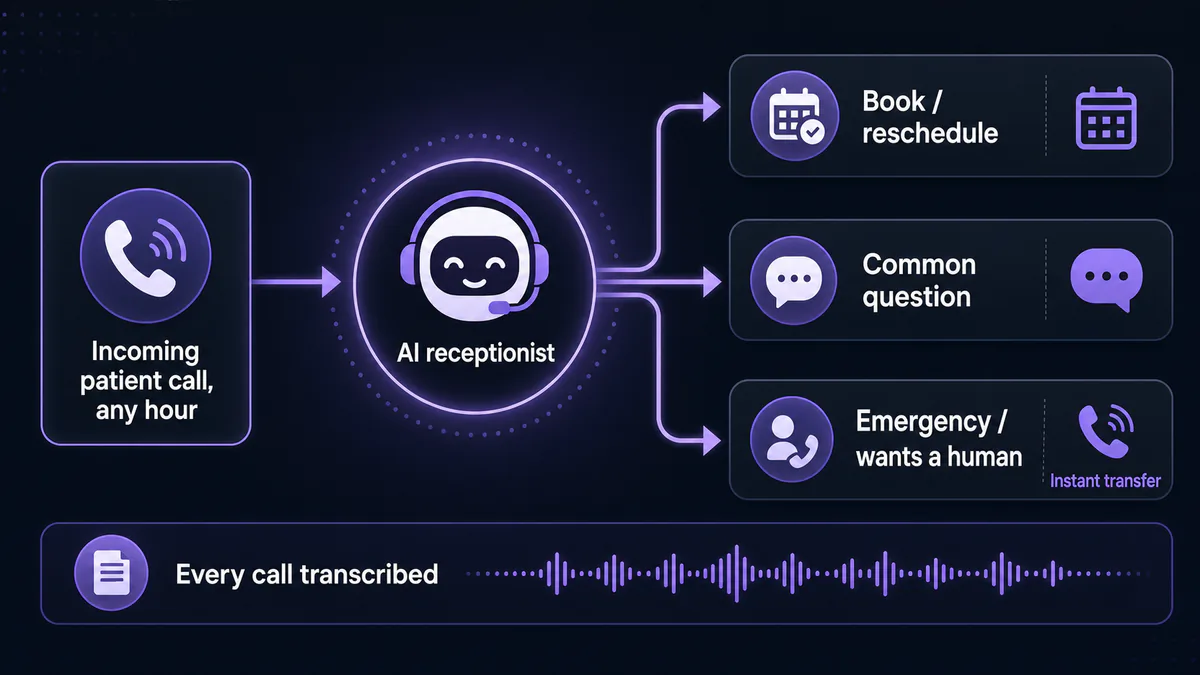
An AI receptionist is a voice assistant that answers your clinic's phone line with a natural, human-sounding voice, around the clock. It is trained on your clinic's information — hours, location, parking, insurance you accept, new patient pricing, what a first visit involves — and connected to your scheduling system so it can book, reschedule, and cancel real appointments during the call.
It is not an old-style phone tree ("press 2 for appointments") and it is not a generic chatbot widget on your website. The patient simply calls your normal number, the AI answers by your clinic's name, has a conversation, and either books the visit or routes the call to a human based on rules you set.
For a chiropractic office, the high-value jobs are specific:
- Answering new patient calls on the first ring, including evenings and weekends when someone has just thrown out their back lifting a kid or shoveling snow.
- Booking and rescheduling adjustments directly into your practice software.
- Answering the same 20 questions your front desk repeats all day — "Do you take my insurance?", "How much is a first visit?", "Do I need a referral?"
- Confirming appointments and chasing no-shows with reminder calls and texts.
- Catching overflow during peak hours so the phone never rings out while your receptionist is helping a patient at the desk.
The Missed-Call Math for a Chiropractic Office
The numbers behind this problem are uncomfortable for any small business, but they hit clinics especially hard because patients in pain shop fast.
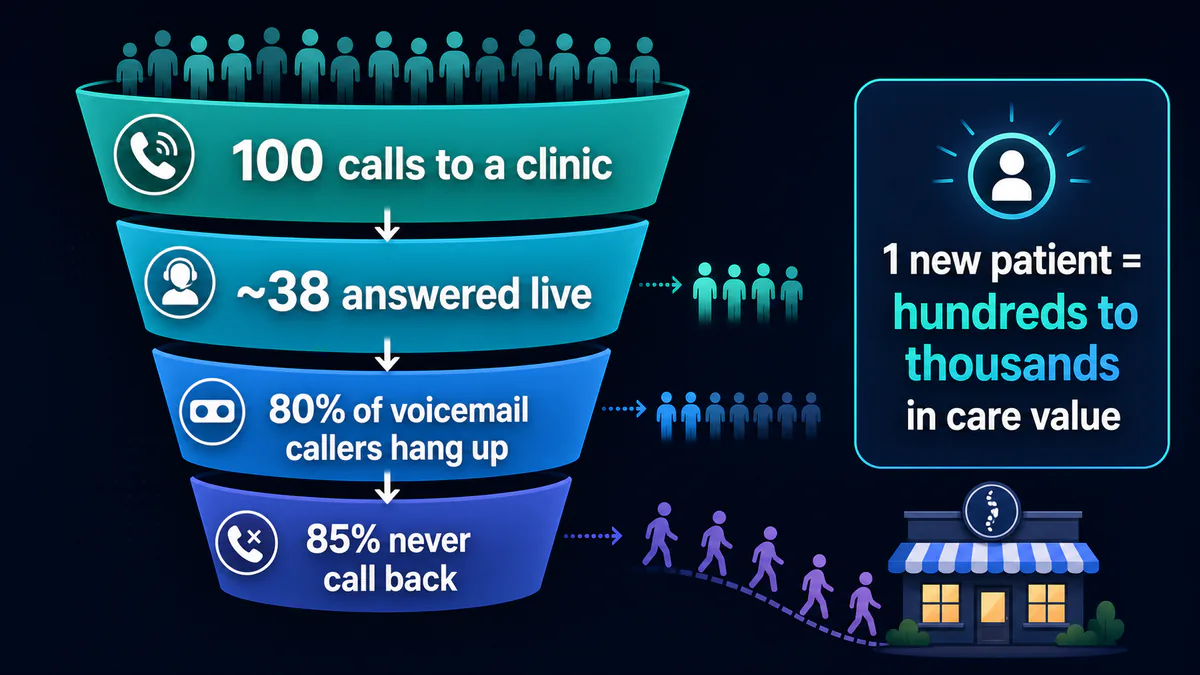
A 2024 call-answering study by 411 Locals across 85 businesses in 58 industries found that only about 38 percent of incoming calls were answered by a live person. The rest went to voicemail or rang out entirely. And caller behavior research consistently shows that roughly 80 percent of callers who reach voicemail hang up without leaving a message, and around 85 percent of them never call back.
Layer on one more stat: industry analyses of business call patterns show that roughly 28 percent of calls arrive outside business hours — and a third or more of those after-hours callers have clear buying intent. For a clinic, "buying intent" means a person in pain who wants an appointment now.
Now do the chiropractic version of the math. A new patient who starts a care plan is typically worth several hundred to a few thousand dollars over the course of treatment, depending on your pricing and retention. If your clinic misses even five new-patient calls a month — lunch hours, evenings, weekends, busy front desk — and just two of those would have booked, you are quietly losing a meaningful chunk of monthly revenue. Every month. While paying for the marketing that made those people call in the first place.
Speed matters even when you do call back. Research from MIT and Harvard Business Review found that responding to a lead within five minutes makes you about 21 times more likely to qualify them than waiting half an hour. A voicemail returned at 9 AM the next morning is, statistically, a lost patient. Around 78 percent of customers end up buying from the business that responds first.
A Day in the Life: What the AI Actually Handles
Here is what a 24/7 AI receptionist does across a normal day at a small clinic:
7:42 AM, before opening. A commuter with neck pain calls on the way to work. The AI answers, explains that the first available slot is 11:30 AM, asks a few intake questions, books the appointment, and sends a confirmation text with your address and parking note.
12:15 PM, lunch rush. Your receptionist is at lunch and two calls come in at once. The AI takes both. One is a reschedule — handled and updated in the calendar. One asks whether you accept their insurance plan — answered from your knowledge base, then offered a booking.
3:30 PM, busy desk. The phone rings while your receptionist is taking a payment. After three rings with no pickup, the AI catches the overflow call instead of letting it hit voicemail.
9:20 PM, after hours. Someone searches "chiropractor near me open Saturday," calls the top three results, and gets two voicemails — and your AI receptionist, which books them for Saturday at 9 AM. This single call pattern is where clinics see the clearest before-and-after difference.
Throughout the day, every conversation is transcribed and logged, so your team starts each morning with a clean list of who called, what they wanted, and what was booked.
What About HIPAA and Patient Privacy?
This is the question chiropractors ask first, and rightly so. In the United States, a phone system that handles patient names, conditions, and appointment details touches protected health information, so the platform behind your AI receptionist needs to support HIPAA compliance — encrypted call data, access controls, and a Business Associate Agreement (BAA) they will actually sign.
Practical rules of thumb:
- Choose a platform that offers a signed BAA, not just a privacy policy page.
- Keep the AI's job scoped to scheduling and general questions. It should never give clinical advice — its script for "Is this treatment right for my condition?" is to book a consultation or pass the call to your team.
- Make sure transcripts and recordings are stored encrypted and you control retention.
- If you are in the UK or Ireland, the equivalent concern is GDPR: you need a data processing agreement, EU/UK data residency options, and clear caller disclosure that the assistant is automated.
None of this is exotic. The serious platforms in this space were built for healthcare front desks and treat compliance as table stakes. The clinics that get in trouble are the ones that wire a generic voice bot to their phone line without asking these questions.
AI Receptionist vs. Hiring vs. Traditional Answering Service
Three ways to stop missing calls, three very different price tags:
A second front desk hire costs roughly $2,800 to $4,200 per month in most US markets once you include payroll taxes — and still cannot answer at 9 PM or take two calls at once.
A traditional human answering service typically runs $135 to $450 per month for small-business plans, but most can only take messages. They do not know your insurance answers, and they usually cannot book into your scheduling software, which means the callback burden lands right back on your team.
An AI receptionist generally costs between $100 and $400 per month depending on call volume and integrations, answers instantly 24/7, handles unlimited simultaneous calls, books directly into your calendar, and never calls in sick. One recovered care plan per month typically covers the subscription several times over.
The honest caveat: an AI receptionist is not better than your best human receptionist at empathy, judgment, or handling an upset patient. That is why the right design is AI plus human, not AI instead of human. The AI takes the volume — after-hours calls, overflow, routine bookings and FAQs — and your front desk handles the conversations that need a person, with both sides connected by clear escalation rules.
Does This Work Outside Big US Cities?
Yes — and honestly, the smaller your market, the bigger the edge. In a city like Austin or Phoenix there are dozens of clinics, and answering first is how you win the comparison shopper. In a smaller town, being the only clinic whose phone is answered at 8 PM on a Sunday makes you the default choice.
The same playbook works for chiropractors and physiotherapy or osteopathy clinics in the United Kingdom and Ireland, as well as Canada, Australia, and New Zealand. The platforms are phone-system agnostic: they work with US and Canadian numbers, UK and Irish numbers, and the major VoIP providers. The only real localization work is your knowledge base — insurance vs. NHS/private mix, local payment norms, and accent/voice selection so the assistant sounds natural to your patients.
At SAM's AI Services, we build these systems for clinics across the United States and other English-speaking markets, and the setup process is the same whether your clinic is in Dallas, Dublin, or Manchester.
How to Get Started Without Disrupting Your Practice
Step 1 — Write down what your front desk says all day. The 20 most common questions and their exact answers, your booking rules, provider schedules, new patient pricing, and your cancellation policy. This takes an afternoon and becomes the AI's training material. Bad knowledge base, bad receptionist — this step matters more than the technology choice.
Step 2 — Connect your phone and calendar. You do not need a new phone number. Calls forward to the AI based on rules: after-hours only, or after three unanswered rings, or all calls with human escalation. Connect your scheduling software so the AI books real slots.
Step 3 — Start with after-hours only, then expand. Run the AI on evenings and weekends for two weeks. Read every transcript. Fix the answers it got wrong. Once it is reliable, turn on daytime overflow. Most clinics are fully live within two to three weeks.
Step 4 — Measure one number: booked appointments from calls that would have been missed. Your platform dashboard will show calls answered after hours and bookings made. That number, multiplied by your average patient value, is your ROI — and it is rarely ambiguous.
If you would rather have all of this configured for you — knowledge base, call flows, calendar integration, escalation rules, and compliance setup — that is exactly what our AI automation service does. It pairs well with the lead follow-up workflows covered in our guide to AI chatbots for business.
Stop Sending New Patients to Voicemail
SAM's AI Services sets up 24/7 AI receptionists for chiropractic and wellness clinics — trained on your clinic's real answers, connected to your real calendar, with humans always one transfer away.
Book a free consultation here or call +1 (415) 287-2654. We will look at your call volume together and tell you honestly whether the math works for your clinic.
Frequently Asked Questions
How much does an AI receptionist cost for a chiropractic clinic?
Most clinics pay between $100 and $400 per month depending on call volume and integrations, plus a one-time setup. That compares to roughly $2,800 to $4,200 per month for an additional front desk hire, or $135 to $450 per month for a traditional answering service that only takes messages.
Can an AI receptionist book appointments directly into my chiropractic software?
Yes. Good platforms integrate with common scheduling systems used by clinics — such as Jane, ChiroTouch, Cliniko, or Calendly — either natively or through connectors like Zapier and Make. The AI books real open slots during the call and sends the patient a confirmation text.
Is an AI receptionist HIPAA compliant?
The technology can be, but compliance depends on the platform and setup. Choose a provider that signs a Business Associate Agreement, encrypts call recordings and transcripts, and limits the AI to scheduling and general questions rather than clinical advice. Clinics in the UK and Ireland should look for GDPR-compliant data processing and data residency options instead.
What happens if a caller has an emergency or needs a human?
You define escalation rules. Calls mentioning emergency symptoms, attorneys, insurance disputes, or an explicit request for a person are immediately transferred to your staff or an on-call number, and the AI sends a transcript so your team has full context before they pick up.
Will patients hang up when they realize it is an AI?
Far fewer than hang up on voicemail. Modern voice AI sounds natural, answers immediately, and resolves the most common requests in under two minutes. Most clinics disclose the assistant honestly and find patients care much more about getting booked quickly than about who answered. The callers you lose to AI hesitancy are a fraction of the roughly 80 percent you currently lose to voicemail.
Does an AI receptionist work for clinics outside the United States?
Yes. The same systems work for clinics in the United Kingdom, Ireland, Canada, Australia, and New Zealand. Setup differences are minor: local phone number routing, GDPR instead of HIPAA in the UK and Ireland, and a knowledge base adapted to local insurance and payment norms.