7 AI SEO Tools That Small Businesses Actually Use
Most AI SEO tools are expensive and complicated. Here are 7 tools small businesses can actually use to rank faster and research smarter.
By SAM's AI Services Team · 2026-04-28
Here is something that does not get said enough about SEO in 2025.
Most of the advice floating around online was written for companies with dedicated SEO teams and $10,000-a-month tool budgets. It is not wrong advice. It is just irrelevant for the overwhelming majority of businesses trying to actually grow their organic traffic.
Small businesses need tools that are fast, affordable, and do not require three certifications to operate. And thanks to the wave of AI-powered SEO tools that have launched in the last two years, those tools now exist.
This guide covers the seven that are actually worth your time, what each one does well, and where each one falls short.
Why AI Changed SEO Faster Than Most People Expected
Traditional SEO has not disappeared. You still need good content, solid technical structure, and backlinks. That has not changed.
What AI changed is the speed and cost of doing all of it. Research that used to take a week now takes an hour. Content outlines that required a specialist now require a prompt. Competitive analysis that needed expensive tooling is now accessible to anyone.
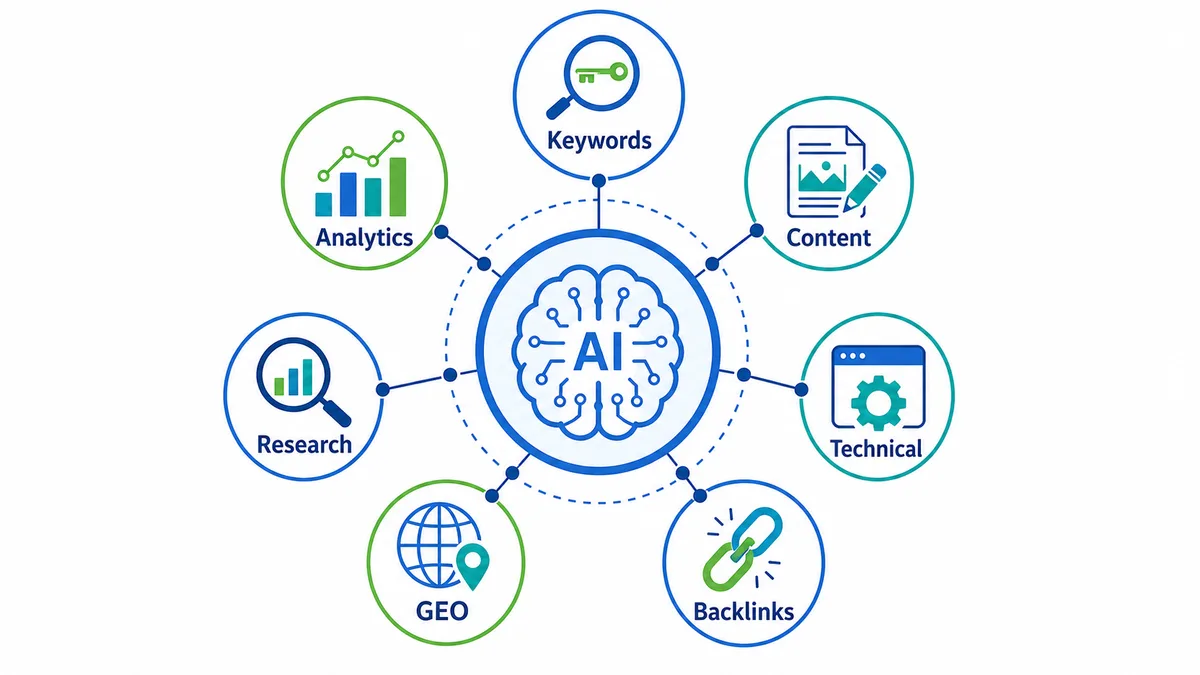
The bigger shift that most people are just starting to understand is the rise of Generative Engine Optimization, or GEO. This is the practice of optimizing not just for Google's search results but for AI systems like ChatGPT, Perplexity, and Google's own AI Overviews. When someone asks an AI assistant a question and it references a source, that source is getting visibility even if the user never goes to the traditional search results page.
If your business is not thinking about GEO alongside traditional SEO, you are already behind. We cover this in detail in our AI SEO and Research services at SAM's AI Services.
Now, the tools.
1. Surfer SEO
Surfer is the tool that turned content optimization into a science. You give it a keyword, it analyzes the top-ranking pages for that keyword, and it tells you exactly what your content needs to include, how long it should be, how many times certain terms should appear, and what questions you should answer.
The AI writing assistant inside Surfer is decent but the real value is the Content Score feature. It gives your article a score from 1 to 100 based on how well it is optimized compared to competing content. Editors use this as their north star when publishing.
Best for: Content teams publishing regularly and wanting a data-driven framework instead of guessing. Pricing: Starts around $89/month. Limitation: The recommendations can feel mechanical if you follow them too literally. Good SEO still requires judgment, not just hitting a score.
2. SEMrush with AI Features
SEMrush is not new but its AI-powered additions are. The platform now includes an AI Writing Assistant, an SEO Content Template that auto-generates content briefs from keywords, and a Keyword Magic Tool that uses semantic clustering to surface related opportunities you would not think to search for manually.
For small businesses, the most valuable feature is the Site Audit. It crawls your website and flags technical issues that are hurting your rankings. Core web vitals, broken links, missing meta tags, slow pages. These are things that kill your Google performance and most site owners have no idea they exist.
Best for: Businesses that want an all-in-one platform and do not want to juggle five different tools. Pricing: Starts at $139/month. Not cheap, but you are replacing several tools. Limitation: Steep learning curve. Overwhelming for first-time users. Takes time to get full value.
3. Perplexity Pro for Research
Most people think of Perplexity as just an AI search engine. It is actually one of the best research tools available for SEO work.
When you are planning a new piece of content, Perplexity can pull together a comprehensive overview of a topic from multiple sources in under a minute. It cites its sources so you can verify. You can use it to understand what the top authoritative sources are saying, which questions are being asked, and where the gaps in current content are.
The Pro version also lets you do custom research prompts and connects to your own documents, which is useful for internal knowledge bases.
Best for: Content research, topic discovery, competitive intelligence at low cost. Pricing: $20/month for Pro. Free tier is useful too. Limitation: Not a traditional SEO tool. No keyword volume data. Use it alongside a keyword tool, not instead of one.
4. ChatGPT for Content Strategy
Every SEO professional worth their rate is using ChatGPT in some part of their workflow. The question is how.
The most effective uses are: generating content outlines from keywords, expanding topic clusters, writing meta descriptions at scale, identifying related long-tail keywords from a seed keyword, and creating internal linking suggestions.
Where it fails is when people use it as a replacement for actual keyword research. ChatGPT does not have real-time volume data. It will suggest keywords that sound reasonable but may have zero actual search demand. Pair it with a real keyword tool and it becomes extremely powerful.
Best for: Content planning, scaling production, meta data creation. Pricing: Free tier works for most SEO tasks. Plus is $20/month. Limitation: No live keyword data. Hallucination risk on specific statistics. Always verify claims.

5. Frase
Frase is probably the most underrated tool on this list for small businesses.
You give it a target keyword. It researches the top Google results for that keyword, extracts the key points from each one, and generates a content brief that shows you exactly what topics to cover to compete. It also has an AI writer built in.
The real differentiator is the Q&A feature. It pulls "People Also Ask" questions from Google and surfaces the exact questions people are searching alongside your target keyword. Answering those questions in your content is one of the most reliable ways to capture featured snippets and appear in AI Overviews.
Best for: Small teams doing content marketing without a dedicated SEO specialist. Pricing: Starts at $45/month. Very reasonable for what you get. Limitation: AI writing quality is average. Use it for research and briefs, not for the final draft.
6. Alli AI
Alli AI is specifically designed to make technical SEO changes at scale without needing a developer for every update. You connect it to your website, it identifies issues, and it lets you fix them with single clicks or rules that apply site-wide.
For small businesses on WordPress or Shopify, this is genuinely valuable. Things like bulk-updating title tags, adding schema markup to product pages, or managing redirects, these usually require either developer time or deep technical knowledge. Alli AI makes them accessible.
Best for: Non-technical business owners who need technical SEO improvements without hiring a developer. Pricing: Starts around $299/month. Higher investment but replaces significant developer hours. Limitation: Primarily for sites with significant content already live. Less useful if you are just starting out.
7. Google Search Console (Free, Always Underused)
Not an AI tool in the traditional sense but Google's own platform now surfaces AI-driven insights about your site performance. Click the "Insights" tab and it will highlight what is working, what is declining, and what opportunities you are missing based on your actual data.
For small businesses, this is the most important tool because it shows you real performance data from Google itself, not estimates from third-party platforms.
Best for: Everyone. Non-negotiable baseline for any SEO effort. Pricing: Free. Limitation: Historical data only. Does not suggest keywords you are not already appearing for.
How to Stack These Tools Without Breaking Your Budget
You do not need all seven. Here is how to think about building a lean, effective AI SEO stack:
Start with Google Search Console (free). This is your foundation. You need to know what is already working.
Add a research layer. Frase or Perplexity Pro for $20-45/month gives you the research firepower to create content that competes.
Use ChatGPT for production. Content briefs, outlines, meta descriptions, and internal linking strategy. Keep a human writing or editing the final copy.
Scale up with Surfer or SEMrush when your content volume justifies it.
That is a complete AI SEO stack for under $70/month that most small businesses can run effectively.
What About GEO and AI Overviews?
This is the frontier right now. If you have noticed that Google now shows AI-generated summaries at the top of many search results, you have seen what is called SGE or AI Overviews. These pull from web content but they do not always credit the source in a way that drives traffic.
The emerging discipline of GEO focuses on getting your business mentioned and cited by AI systems. This involves structured data, entity-building, and creating content that AI systems treat as authoritative.
It is still early. Nobody has this completely figured out. But the businesses investing in it now are going to have a significant head start in 12 months.
At SAM's AI Services, our AI SEO and Research service covers both traditional search optimization and GEO positioning, because both are going to matter for the foreseeable future. If you want to talk about what this looks like for your specific business, call us at +1 (213) 685-2334.

The One Thing Most Small Businesses Get Wrong About AI SEO
They treat AI tools as a way to produce more content faster without worrying about quality.
Google has been very clear that it can detect low-quality AI content and will not rank it. The businesses winning with AI SEO are using these tools to research better, structure better, and edit more efficiently. The AI handles the heavy lifting so the human can focus on adding genuine insight and accuracy.
More content is not the goal. Better-optimized content that genuinely answers what people are looking for is the goal.
That distinction is the difference between AI SEO working and not working for your business.
Where to Start This Week
Pick one thing from this list and actually do it.
If you have not set up Google Search Console, do that today. It takes 10 minutes.
If you have content on your site that is getting some traffic but not ranking on page one, use Frase or Surfer to analyze the gap between your content and what is ranking above you.
If you are not sure where your website stands from a technical SEO perspective, we can take a look. The first conversation is free. Reach out here or call +1 (213) 685-2334.
SAM's AI Services helps small and mid-sized businesses across the USA grow their organic search visibility using AI-powered SEO strategies. Learn more at samsaiservices.com.